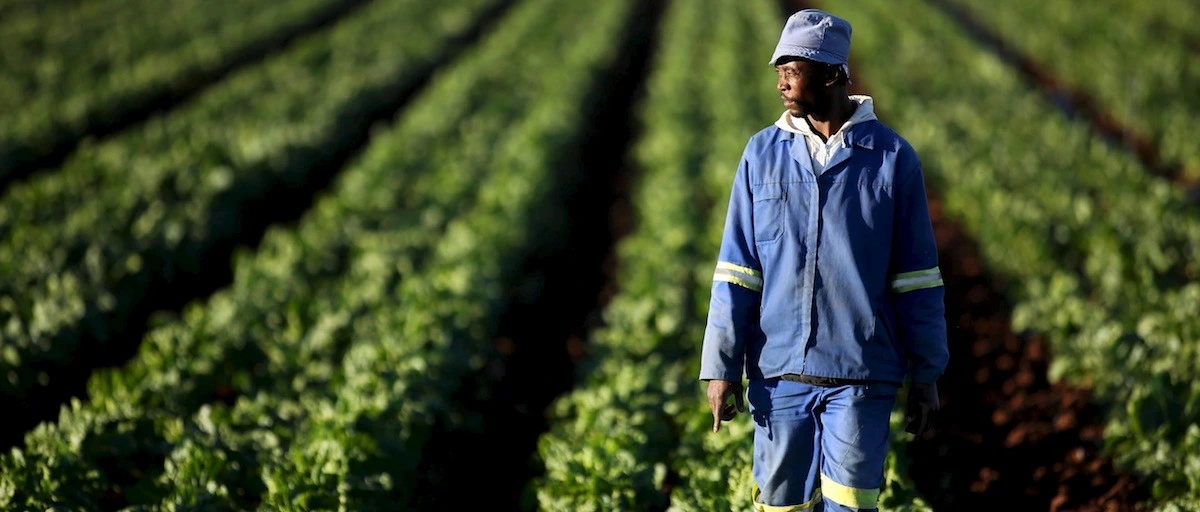
A historical Perspective on Land Reform
South Africa’s journey towards land reform is rooted in over a century of profound land dispossession, racial segregation, and systemic inequality. The story of land reform in the country is a story of struggle, resistance, and ongoing challenges, all of which can be traced back to the landmark 1913 Natives Land Act. The ripples of this historical injustice continue to shape South Africa’s political and social landscape today.
A Dark Beginning: The 1913 Natives Land Act
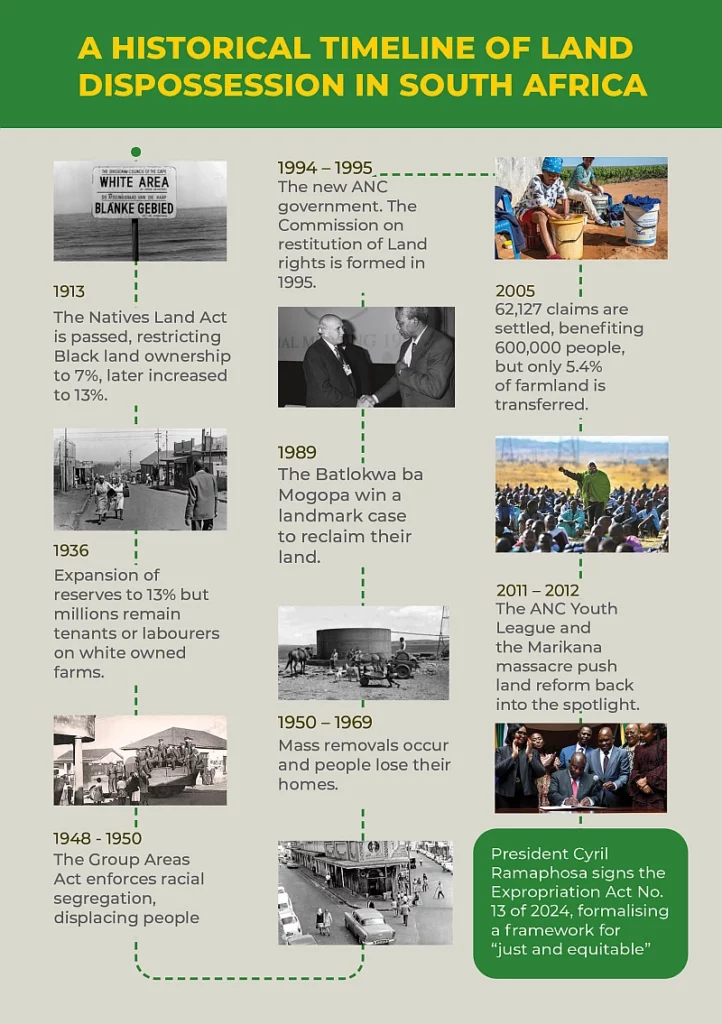
In 1913, the passing of the Natives Land Act was a defining moment in South Africa’s history. This legislation marked the beginning of legal land dispossession, which restricted Black South Africans from owning land in the majority of the country. Sol T. Plaatje, a prominent journalist and political figure of the time, captured the essence of this bleak moment with his haunting words: “Awaking on Friday morning, June 20, 1913, the South African Native found himself, not actually a slave, but a pariah in the land of his birth.”
The Natives Land Act allocated only 7% of the country’s land for Black ownership. Over time, this would expand to a mere 13%, a stark contrast to the 87% of land held by the white minority. This unjust division set the stage for generations of dispossession and suffering.
The Expansion of Dispossession: 1936-1959
The next several decades saw further entrenchment of racial segregation in land ownership. In 1936, the Native Trust and Land Act expanded the reserves for Black South Africans, but only to 13%, solidifying racial divisions. In the following years, laws like the Native Urban Areas Act and the Group Areas Act led to the forced removals of entire communities from urban centers, including places like Sophiatown and Lady Selbourne. The 1950s and 1960s were marked by the violent destruction of vibrant communities, with over 60,000 people displaced from areas like District Six in Cape Town.
During the apartheid era, the introduction of Bantustans and policies of forced removals intensified land dispossession, creating a spatial reality that continues to affect the lives of millions of South Africans today.
The Struggle for Justice: The Road to Restitution
The long road to land restitution began in the early 1990s with the fall of apartheid. Following the first democratic elections in 1994, the ANC government made land reform and restitution a top priority. The Commission on Restitution of Land Rights was established in 1995 to investigate land claims, but its progress was slow, and the scale of the task proved overwhelming. By 1999, only 670 out of 70,000 land claims had been settled.
The post-apartheid era saw the introduction of several reforms aimed at returning land to the dispossessed. However, despite some progress, the pace of land redistribution remained insufficient. By 2005, only 5.4% of commercial farmland had been transferred to Black ownership, far below the government’s target of 30% by 2014.
A New Era of Debate: Land Expropriation Without Compensation
The debate over land reform reached new heights in the 2010s, with a push from the ANC Youth League for the nationalization of land without compensation. Public opinion became more divided after the Marikana massacre in 2012, which brought issues of inequality and land reform to the forefront.
In 2018, the National Assembly passed a motion to explore land expropriation without compensation. Public consultations were held, and while there was widespread support for expropriation, concerns about the economic viability of such a policy persisted, especially from the white farming community. The issue took center stage again in 2019 when the Constitutional Review Committee introduced a draft bill to amend Section 25 of the Constitution, aiming to allow land expropriation without compensation. Although the bill did not secure the required parliamentary majority, it remained a key issue for national debate.
Recent Developments and Future Prospects
The South African government has continued to grapple with the complexities of land reform. In 2020, the Expropriation Bill was introduced, outlining a legal framework for expropriation and clarifying how the government would approach land redistribution. The bill provides a distinct path for land expropriation without constitutional amendments and ensures that expropriations are carried out in a fair and just manner.
In 2025, after years of deliberation, President Cyril Ramaphosa signed the Expropriation Act into law. This landmark moment concluded a long process that began in the early 2000s, with updates in 2015 and 2020. The Act now governs the procedures for land expropriation, providing clear guidelines for “just and equitable” compensation, aligning with constitutional principles of fairness and equity.
The Way Forward: A Nation in Transition
As South Africa moves forward with land reform, the challenges of restitution, redistribution, and transformation continue to unfold. Over a century of land dispossession cannot be undone overnight, and while progress is being made, it is clear that the process of healing and rebuilding is far from complete.
The nation stands at a critical crossroads: will the land reform process unlock opportunities for economic empowerment and reconciliation, or will it deepen divisions? The answer lies in the ability to balance the needs of the dispossessed with the economic realities of the country. One thing is certain—land reform remains an essential pillar of South Africa’s journey toward equality, justice, and social stability.
Copyright Brand South Africa © 2025. All rights reserved - Reengineered by Pii Digital