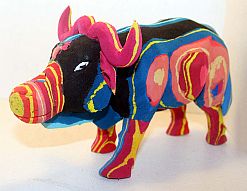

 A colourful buffalo, skillfully crafted from
flip-flops glued together and then carved.
(Image: UniqEco)
 A small fraction of the thousands of
discarded flip-flops that wash up on
Kenya’s shores. (Image: UniqEco)
 Colourful and stylish earrings are just
one of the imaginative variety of products
fashioned from flip-flops.
(Image: UniqEco)
 A Kenyan woman making beauty from waste.
(Image: Elspeth Murray)

Janine Erasmus
BBC World Challenge finalist UniquEco has turned a potential environmental disaster in Kenya into an income for local crafters – making colourful jewellery and other products from discarded flip-flops that wash up on the country’s shore.
The flip-flops arrive in their thousands on Kenya’s northern coast, brought there by the Indian Ocean tides from far-away Asian countries such as Japan, Indonesia, Malaysia and China. The footwear is made from indestructible rubber, which boded ill for the health of the marine ecosystem – until UniquEco, the (Flipflop) Recycling Company, stepped in.
The non-profit company seized the opportunity to help generate a sustainable income for women and youths from coastal communities, while simultaneously helping the environment. Not only are the beaches saved, but also the sea creatures that try to eat the rubbery objects and hatchling turtles that have to negotiate their way to the water through the footwear flotsam, often unsuccessfully.
UniquEco was started in 2005 by two enterprising Kenyans, Tahreni Bwanaali and Julie Church. Marine conservationist Church had been working since 1997 on a turtle conservation project with the Worldwide Fund for Nature in Kenya, and noticed that children from communities adjacent to the Kiunga Marine National Reserve would fashion the washed-up flip-flops into crude, if colourful, toy boats.
“I saw that something imaginative, artistic and inspirational could come from something disposed of, rejected and discarded,” commented Church. She also wished to develop basic business skills for the community, and, realising the potential in the virtually limitless supply of flip-flops, slowly grew her idea into a project for making key rings, serviette holders and placemats.
Her clients included the Worldwide Fund for Nature, Switzerland, which placed a substantial order for 20 000 flip-flop key rings. Church brought partner Bwanaali, originally from the area and holder of a master’s degree in business management, on board in 2005 to establish UniquEco and give the project a formal business structure.
“We knew something had to be done,” said Church. “The indestructible rubber from the flip-flops spoils the natural beauty of the beaches.”
Besides its recognition as a World Challenge finalist, the project was recently featured on the front page of the website for the United Nations Environmental Programme‘s Climate Neutral Network.
Thousands of flip-flops are gathered and cleaned, then glued into blocks and carved into one-of-a-kind shapes by local communities. The shapes are sent to UniquEco’s head office in Nairobi to be further adorned with beads and other elements, and off-cuts are shredded to make cushion stuffing.
Thus is potentially hazardous debris cunningly transformed into a variety of products ranging from useful household items such as bowls, bottle stops and coasters, to ingenious toys, to eye-catching earrings, necklaces and belts.
Products are sold through outlets around the world, and thanks to UniquEco, communities in the area now have an alternative source of income. This reduces their need to over-exploit their natural resources through fishing, the area’s previous main industry. At the same time, almost 150 km of Kenya’s beaches are kept clean.
To raise global awareness around the impact of pollution of animal habitats and the benefits of recycling, UniquEco also commissioned two life-sized flip-flop sculptures – one a whale, the other a giraffe.
Mfalme wa Bahari (Swahili, meaning “king of the ocean”), the flip-flop Minke whale, was constructed at Marula Studios in Karen, Nairobi. The creature consists of a metal frame covered with thousands of pieces of flip-flop rubber.
Mfalme was part of a joint project between UniquEco, the Nairobi-based Coastal and Marine Secretariat of the New Partnership for Africa’s Development, and the World Society for the Protection of Animals. Its mission was to generate greater understanding of whaling and its impact on whales and their habitats, as well as awareness of marine pollution and its effects on ecosystems. Kenya is a signatory to the International Whaling Commission, the body that regulates the whaling industry.
It is expected that Mfalme will find a permanent home in London’s Natural History Museum as a statement from African communities against global pollution and whaling.
Twiga (Swahili, meaning “giraffe”) was created by UniquEco, working with the International Trade Centre, to raise awareness around recycling. Also constructed from flip-flops glued over a metal frame, Twiga has travelled to Rome, Geneva and Paris as an ambassador for recycling.
The creature was the star of the show at the 2008 Rome Fashion Week and was displayed in 2008 at the World Trade Organisation and at the World Export Development Forum in Switzerland. It stood at the Palais des Nations in Geneva, the Swiss offices of the United Nations, until January 2009.
The World Challenge 08 is a global competition that recognises and rewards projects or small businesses from around the world that show innovation at grassroots level. The two main partners are BBC World News and Newsweek, in association with Shell.
In 2008 South Africa’s Heiveld Co-operative made it onto the list of finalists, with its organic rooibos tea initiative that pays local farmers a fair price for the product and then markets and exports the popular beverage to growing markets abroad.
Copyright Brand South Africa © 2025. All rights reserved - Reengineered by Pii Digital