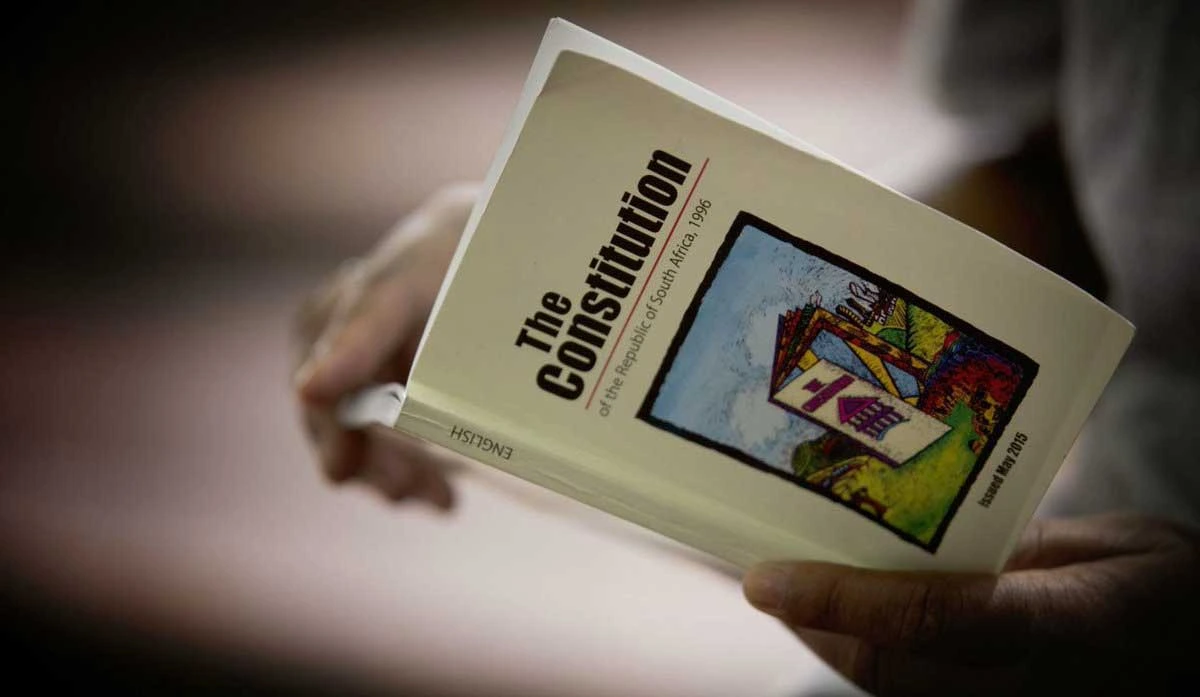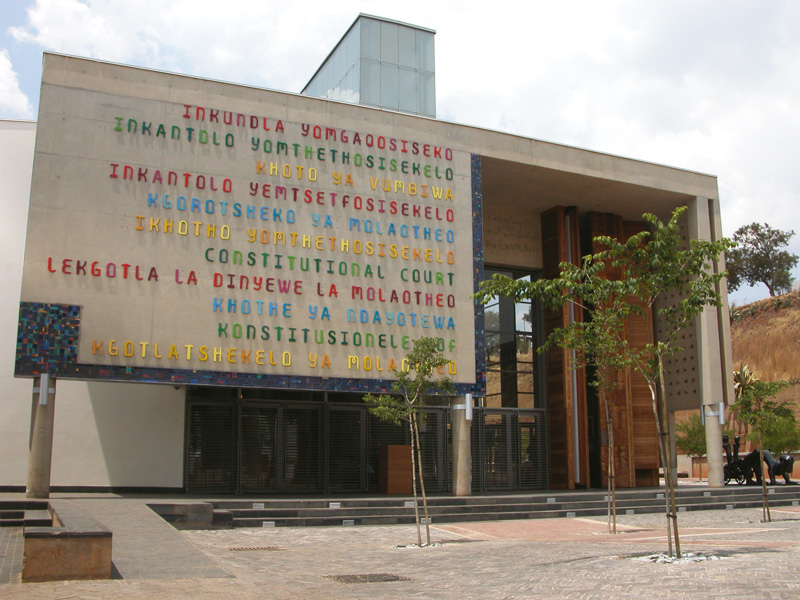
The Constitution Hill precinct, located just west of Hillbrow in Johannesburg, is the seat of the Constitutional Court of South Africa, the highest court in the country in terms of matters relating to the Constitution.
The Constitutional Court building on Constitution Hill in the Johannesburg inner city is now 10 years old. (Image: South African History Online)
Formerly a fort and then a notorious prison, the precinct is full of history and it’s fitting that a light, airy and altogether public court now resides on the premises.The theme of the precinct in “justice under a tree” and refers to the age-old African practice of people gathering under a tree to discuss important matters. This theme is carried through the building in a number of different ways.
Click on a thumbnail for a low-resolution image, or right-click on the link below it to download a high-resolution copy of the image.

The building which houses the judges’ chambers, the courtroom, the law library and the art gallery. |

As with the front of the building, the words “Constitutional Court” in all eleven official languaes can be seen on the side. |

The Angry Godzilla, a three-metre-high statue carved from a single leadwood tree by artist John Baloyi, stands guard at the northern end of the court building. |

The Great African Steps lead up to Constitution Square and the entrance to the main building. |

Constitution Square was built on the site of the old awaiting trial block, which dates back to 1928. |

Three of the staircases from the awaiting trial block have been preserved. Bricks from the building were preserved and used to build the courtroom and the Great African Steps. |

The words “Constitutional Court” in all eleven official languages. |

“History” by the late Dumile Feni is often mistaken for a slavery statement, but the artwork actually depicts people moving forward by carrying each other. |

The eternal flame of democracy burns in one of the old awaiting trial stairwells. |

The word “freedom” is inscribed on the bowl’s rim. Before it arrived in Johannesburg, the flame was lit in 2011 by former president Nelson Mandela at his Eastern Cape home, and the flame passed through the hands of all the judges before it touched the bowl. |

The doors to the court building feature the 27 fundamental themes of the Bill of Rights in all official languages, plus sign language. |

The magnificent doors stand nine metres high, and are a work of art in their own right. |

High above the doors, each of the judges presiding when the building was constructed inscribed the words equality, dignity and freedom in their mother tongue into the concrete. |

The foyer continues the theme of “justice under a tree” and is built to resemble a stand of trees where people would traditionally gather to discuss problems. |

The foyer is airy and welcoming, with tall tree-like pillars and delicate silver wire chandeliers, designed to look like the leaves of the forest canopy. |

The phrase “A luta continua” (Portuguese, meaning “the struggle continues”) is written in neon on the wall. It refers to the ongoing process of transformation, but was also the rallying cry of the Mozambican Frelimo freedom movement in the 1960s and 70s. |

The foyer is designed to make the most of natural light, and gives a welcoming feeling to those who enter. |

Inside the courtroom, which is always open to the public, the judges’ seats are covered with hide from the hardy indigenous Nguni cows – each one is different, symbolising the different characteristics that each judge brings to the bench. |

The panels in front of the window, as well as the South African flag, were made by hand. The flag is beaded and was crafted by unemployed women from a rural beadwork workshop. The panels symbolise clouds in the sky, and their theme is echoed in the carpet, which looks like the shadows of clouds on the ground. |

The digitally-woven tapestry is by Marlene Dumas, one of the country’s most distinguished artists. Titled The Benefit of the Doubt 2, its themes are law, justice, innocence and freedom. |

Justice under a tree – the symbol of the Constitutional Court at the entrance to the courtroom. |

While the art gallery houses many fine pieces, one could also argue that the entire building is a work of art. |

The bulk of the collection was assembled by former Constitutional Court judge Albie Sachs, over a ten-year period. |
|
Would you like to use this article in your publication or on your website? See Using Brand South Africa material.
Copyright Brand South Africa © 2025. All rights reserved - Reengineered by Pii Digital