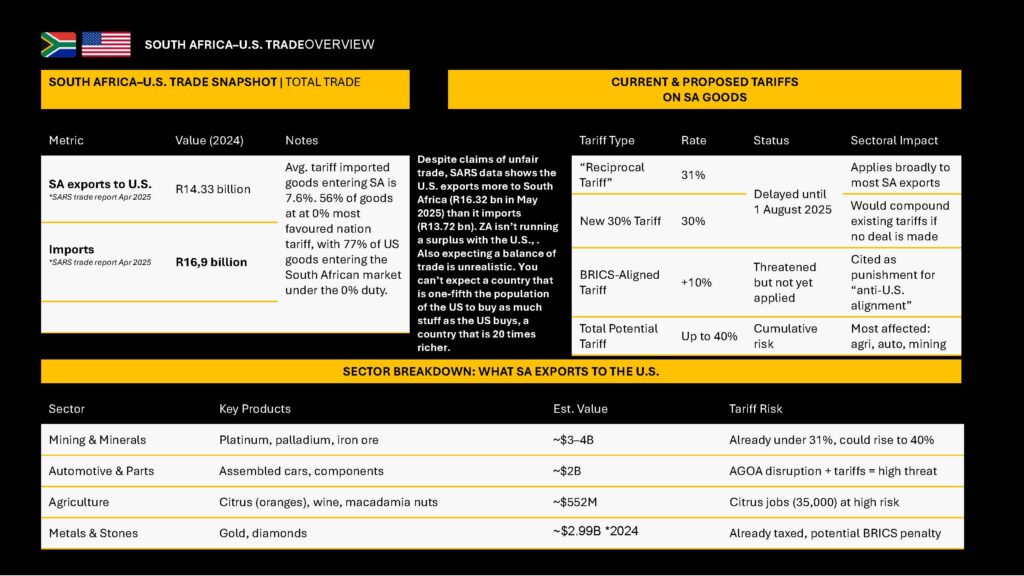
In early July, the United States announced renewed and expanded tariffs on 14 countries, including South Africa, as part of a broader recalibration of its trade posture under former President Donald Trump’s reinstated administration. Among the most significant measures: a 30% tariff on most South African exports, compounding pre-existing Section 232 duties of 25% on vehicle components and 50% on metals. For South Africa, these moves do not represent an economic rupture – but rather, the latest development in a shifting global trade environment for which it has been actively preparing.
Notably, a substantial portion of South Africa’s exports – particularly in strategic minerals—remain exempt. Platinum-group metals (PGMs), coal, gold, manganese, and chrome have all been carved out of the tariff list. This exemption is not incidental. In 2024, South Africa exported approximately R65.3 billion in minerals and metals to the United States, with PGMs accounting for more than three-quarters of that value. These materials are critical inputs for U.S. industries, particularly automotive manufacturing, where there are few viable substitutes. Two-thirds of U.S. platinum imports originate from South Africa; restricting access would undermine the very sectors Washington aims to protect.
The message is clear: despite tensions, economic interdependence continues to shape bilateral choices.
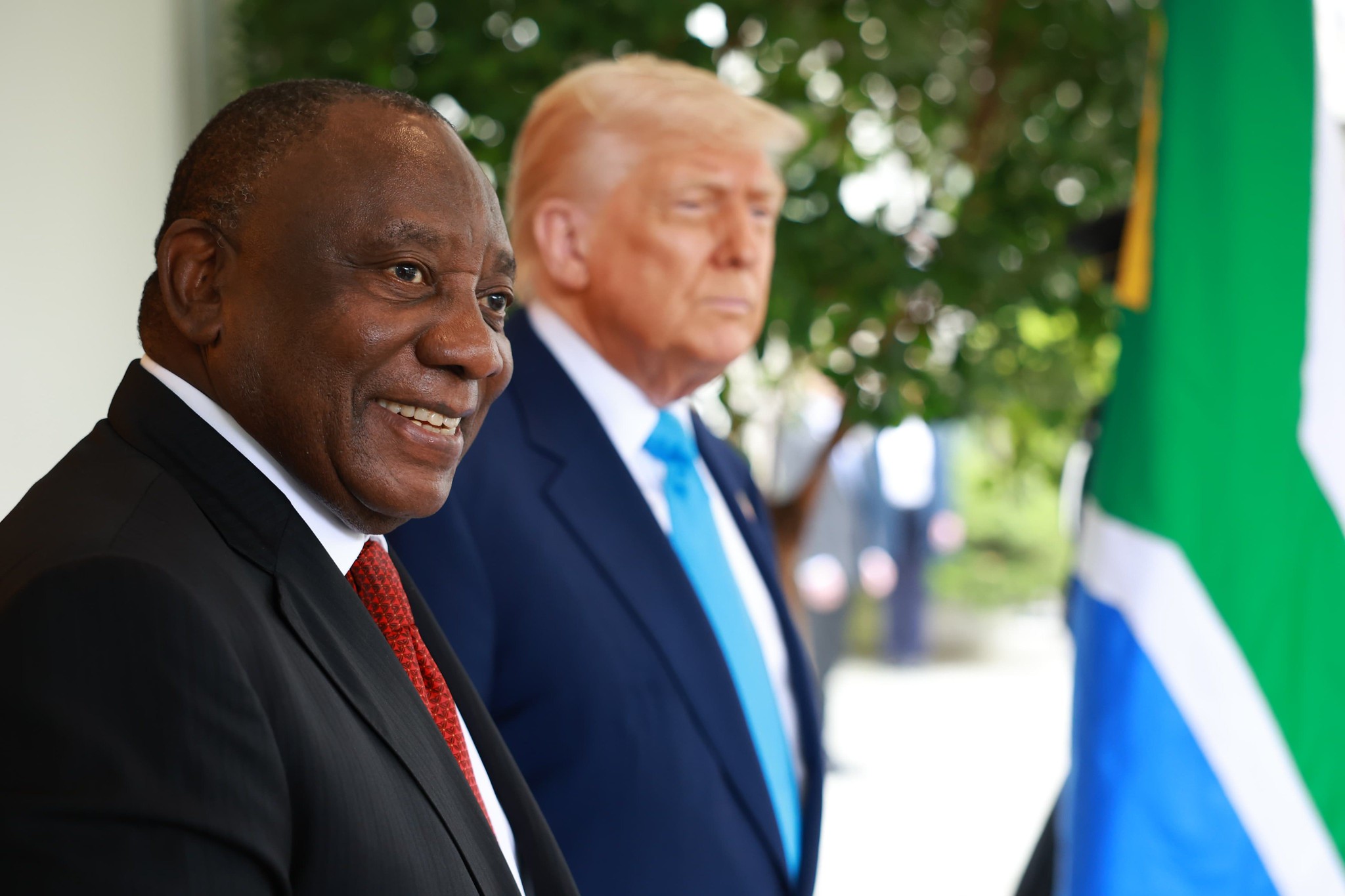
Rather than escalate President Ramaphosa’s administration has initiated a round of negotiations, including proposals for LNG purchases and selective concessions, aimed at securing more durable sectoral exemptions. Trump’s own correspondence leaves room for such adjustments, stating that tariff levels may be altered “depending on our relationship with [your] country.” South Africa has formally requested an extension to the July 9 deadline and is pursuing targeted relief in high-impact sectors such as auto parts and refined metals.
This is a strategic response – grounded in the reality that the current U.S. tariff posture is not necessarily permanent, nor wholly ideological. As with the 2018–2019 U.S.–China trade conflict, such measures may ultimately be designed to extract leverage rather than to impose structural decoupling. In that earlier round of tariffs, Chinese exporters rebalanced toward alternative markets in Europe, Africa, and Latin America. South Africa, too, has spent the past several years laying the groundwork for similar resilience.
The African Continental Free Trade Area (AfCFTA) has opened new intra-African pathways for goods, services, and investment. Simultaneously, South Africa’s Economic Partnership Agreements with the European Union and the UK remain intact, offering exporters favourable terms and reliable regulatory environments. Diversification is no longer a long-term ambition—it is now an active component of trade strategy.
The U.S. remains South Africa’s second-largest export destination and an important source of investment. But the inverse is also true: the U.S. relies on South Africa not only for raw materials, but for access to the African market more broadly. Over 220,000 jobs in South Africa are linked to American firms, and bilateral cooperation in fields ranging from energy to finance continues despite trade tensions.
If there is an emerging consensus among South African officials, it is that disengagement would be mutually detrimental. Tariffs of this scale inevitably produce short-term uncertainty, but they also bring longer-term clarity about where strategic alignments must be reinforced. South Africa is responding accordingly—not by withdrawing, but by recalibrating. The goal is not confrontation, but insulation: ensuring that no single market disruption can destabilise national supply chains or investment flows.
Whether Washington seeks to reset or to rupture, South Africa’s position is increasingly clear. It is acting deliberately, with an eye toward structural resilience and multilateral engagement. The tariffs may bite—but they do not break the broader trajectory.
Copyright Brand South Africa © 2025. All rights reserved - Reengineered by Pii Digital