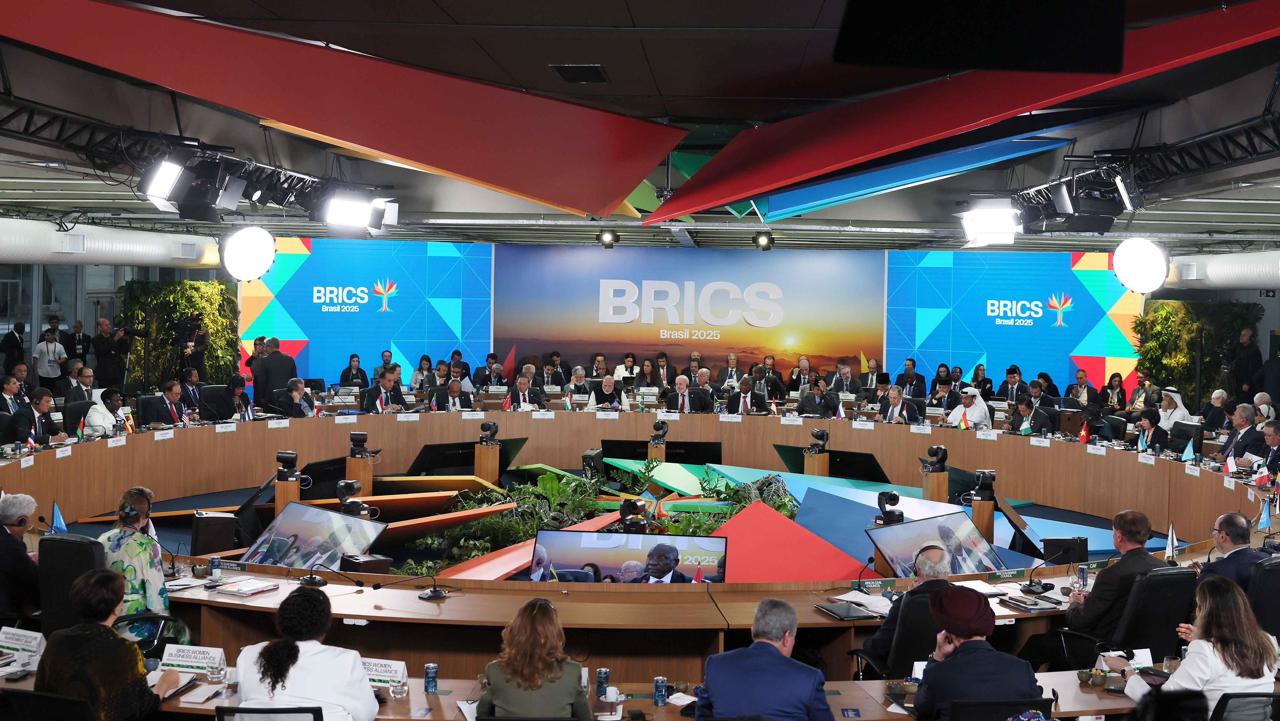
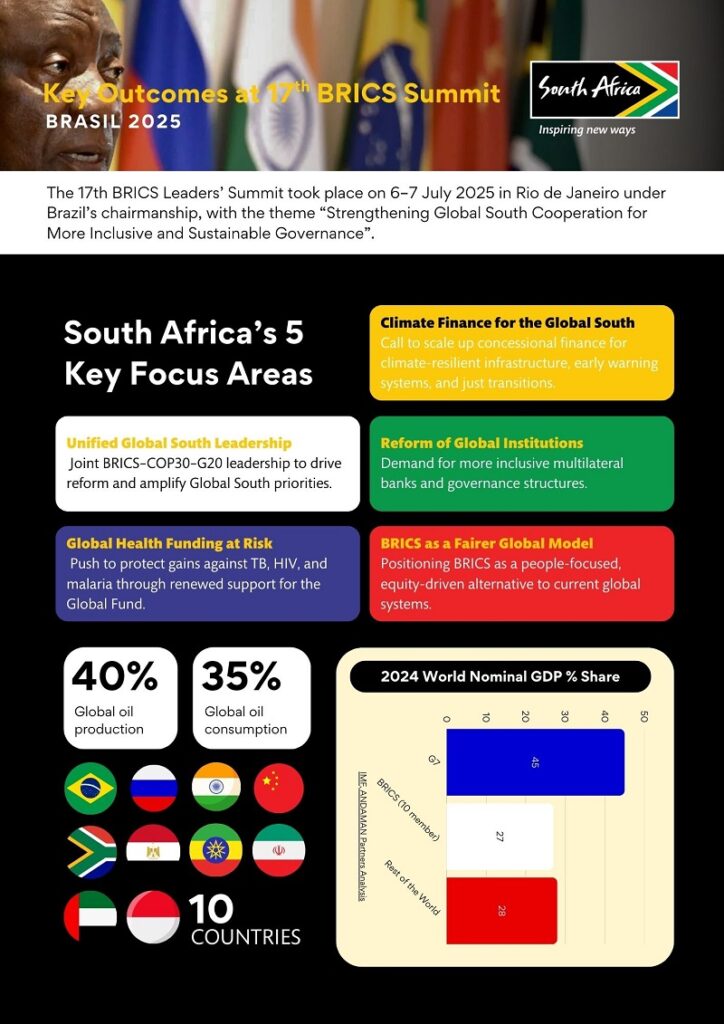
The 17th BRICS Leaders’ Summit was held from 6–7 July 2025 in Rio de Janeiro under Brazil’s chairmanship. Convened under the theme “Strengthening Global South Cooperation for More Inclusive and Sustainable Governance”, the Summit took place at a time of increasing geopolitical tension, particularly with renewed U.S. tariff threats directed at BRICS-aligned countries. It marked the first full gathering of the expanded BRICS bloc – now comprising 11 major emerging economies – and included several outreach partners.
South Africa, led by President Cyril Ramaphosa and a senior ministerial delegation, used the platform to advance strategic priorities around trade diversification, multilateral governance reform, climate action, and digital cooperation. The summit concluded with the adoption of the Rio Declaration and a suite of framework agreements that broadly align with South Africa’s agenda in the Global South.
Contextual Dynamics and Summit Significance
The Rio Summit unfolded amid significant global realignments. President Ramaphosa characterised the current moment as one of “dramatic reshaping” across political, economic, technological, and environmental spheres—highlighting both risks and opportunities for developing countries. A particular point of tension came days before the summit, when U.S. President Donald Trump announced a blanket 10% tariff targeting countries aligning with BRICS, intensifying concerns about retaliatory trade practices.
BRICS leaders responded collectively, warning that such measures could further fragment global commerce and disproportionately harm developing economies. These concerns reinforced South Africa’s core diplomatic message: the need for diversified trade routes and reduced reliance on any single market.
South Africa’s Strategic Objectives
According to the Department of International Relations and Cooperation (DIRCO), South Africa’s key goals at the Rio Summit were as follows:
Watch: President Ramaphosa’s Wrap-Up Interview at BRICS XVII
President Ramaphosa consistently framed South Africa’s engagement through these priorities, asserting that Brazil’s dual role as BRICS Chair and upcoming COP30 host, alongside South Africa’s forthcoming G20 presidency, presented a rare alignment of global platforms. This convergence, he argued, offers the Global South a powerful opportunity to drive a shared agenda for inclusive development.
Key Policy Contributions and Diplomatic Positions
South Africa also expressed strong support for the 2030 BRICS Economic Partnership Strategy, noting its alignment with the country’s industrialisation, export diversification, and regional integration objectives.
On climate finance, South Africa called for BRICS to jointly develop a five-year roadmap to mobilise resources for climate mitigation and adaptation. The proposal included leveraging the scale of BRICS economies to secure fairer global financing terms and to ensure that climate action supports both environmental and developmental goals.
Summit Outcomes Aligned with South Africa’s Priorities
The Rio Declaration and associated documents reflected several of South Africa’s strategic positions:
Strategic Implications for South Africa and the Global South
South Africa’s active participation in the 17th BRICS Summit reinforced its diplomatic and economic positioning within the Global South. The summit not only affirmed BRICS’ growing geopolitical relevance – now representing nearly half of the global population and over a third of world GDP – but also strengthened South Africa’s role as a mediator between emerging powers and global institutions.
In the context of rising protectionism and great-power competition, the outcomes of the summit support South Africa’s strategic imperative to diversify trade, attract new investment flows, and expand influence within multilateral decision-making forums. By aligning BRICS initiatives with COP30 and the upcoming G20 presidency, South Africa has placed itself at the centre of the evolving global development agenda—contributing not only to Africa’s interests, but also to broader questions of equity, sustainability, and reform.
Copyright Brand South Africa © 2025. All rights reserved - Reengineered by Pii Digital