By Lethabo Mkhize
The South African Budget Speech 2025/26, delivered by the Minister of Finance on March 12, 2025, outlines a financial roadmap for the country amid economic challenges and ongoing fiscal constraints. With a total consolidated government expenditure of R2.59 trillion, the budget aims to balance economic recovery, social welfare, and infrastructure development while addressing rising debt and funding constraints.
Major Budget Allocations for 2025/26
The government’s expenditure is divided into key areas, with the largest portions allocated to social services, economic development, peace and security, and public services. Here’s a detailed breakdown:
Social services make up the largest share of the budget, focusing on education, healthcare, community development, and social grants.
The education sector remains the highest-funded priority in the budget, receiving R508.7 billion. Basic education alone accounts for R332.3 billion, ensuring continued investment in schools, teacher salaries, and learning materials. Additionally, the National Student Financial Aid Scheme (NSFAS) receives R55.4 billion, supporting university students from disadvantaged backgrounds. Other allocations include university transfers (R48.4 billion), skills development (R27.9 billion), and technical and vocational education (R14.2 billion).
South Africa’s public health system is a key focus area, receiving R298.9 billion. This includes district health services (R132.1 billion), central hospital services (R58.3 billion), and provincial hospital services (R49.0 billion). Additional funds are directed toward other health services (R47.5 billion) and hospital maintenance (R11.9 billion), reflecting the government’s efforts to strengthen healthcare infrastructure.
Municipalities and urban development receive R286.6 billion, aimed at improving public transport (R67.7 billion), human settlements (R58.0 billion), and municipal infrastructure (R54.8 billion). The Municipal Equitable Share program, at R106.1 billion, ensures direct funding for local governments to enhance service delivery.
South Africa’s social welfare system continues to expand, with R422.3 billion allocated to grants and social assistance. The old-age grant receives R117.4 billion, while the child-support grant accounts for R90.4 billion. Other social security funds, including disability and foster care grants, total R99.5 billion, demonstrating a commitment to supporting vulnerable citizens.
To stimulate economic growth and job creation, the government has allocated R289.8 billion to various development initiatives. Infrastructure and economic regulation receive R175.7 billion, followed by industrialisation and exports at R40.8 billion. Support for agriculture and rural development (R29.4 billion) and job creation initiatives (R23.7 billion) highlights the importance of sustainable employment opportunities. Science, technology, and innovation programs are funded at R20.2 billion, ensuring investment in future-focused industries.
Safety and security remain a priority, with R266.1 billion directed towards law enforcement, defense, and public safety. Police services receive R133.4 billion, the defense budget stands at R60.8 billion, and law courts and prisons are funded at R58.1 billion. Home Affairs receives R13.9 billion to strengthen immigration control and identity documentation systems.
The administration of government functions, legislative operations, and diplomatic relations receives R78.7 billion. This includes public administration and fiscal affairs (R51.7 billion), executive and legislative organs (R17.8 billion), and external affairs (R9.1 billion).
9. Debt-Service Costs – R424.9 Billion
One of the most significant concerns in the budget is the debt-service cost of R424.9 billion, reflecting the government’s struggle with managing rising public debt. This allocation highlights the burden of loan repayments on South Africa’s fiscal position.
10. Contingency Reserve – R5.0 Billion
A contingency reserve of R5.0 billion is set aside for unexpected financial shocks, ensuring that the government can respond to emergencies without disrupting core services.
Key Takeaways from the 2025/26 Budget Speech
The budget reinforces the government’s commitment to social support, with major increases in education, healthcare, and social development funding. Grants for the elderly, children, and the unemployed remain key focus areas. Social grants receive R422.3 billion, including:
At R424.9 billion, South Africa’s debt repayments continue to be a major fiscal concern. This high cost limits the government’s ability to invest in infrastructure and job creation initiatives.
With over R500 billion allocated to learning and culture, the government is prioritising education, youth skills development, and access to higher education through NSFAS funding and university support.
The R289.8 billion allocation to economic development suggests efforts to boost job creation, stimulate exports, and support innovation-driven growth. Key areas include agriculture, industrialisation, and infrastructure development.
Despite fiscal challenges, the government is increasing funding for hospitals and primary healthcare services, ensuring better access to medical care across the country.
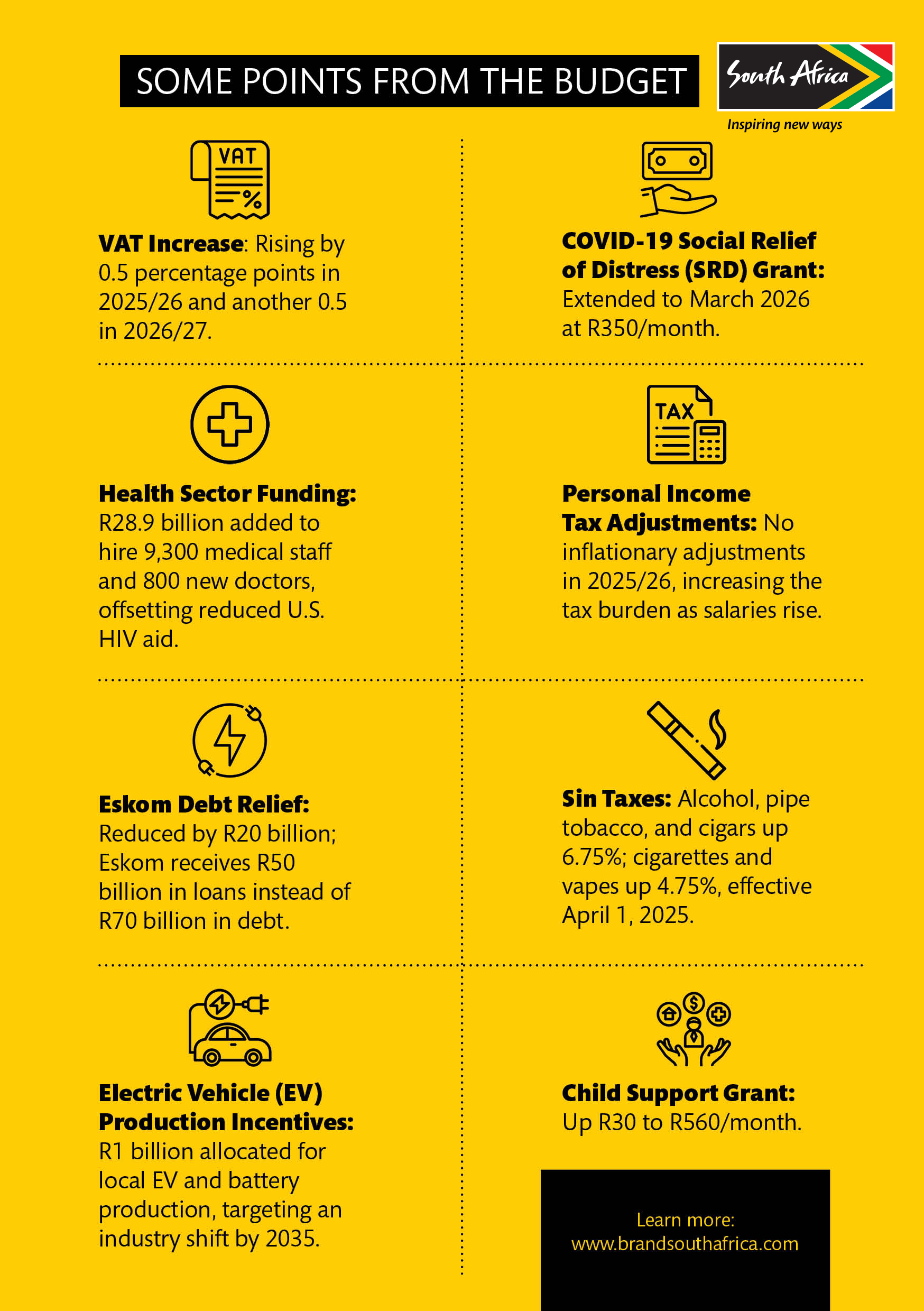
To fund the growing budget, the National Treasury is considering raising VAT by 0.5% in 2025, bringing it to 15.5%, with another potential increase in 2026.
The 2025/26 budget reflects a balance between social support and economic sustainability. While increased spending on education, healthcare, and infrastructure is positive, rising debt-service costs and potential tax hikes remain concerns. The government faces the challenge of ensuring fiscal responsibility while promoting economic growth and job creation.
With education and social grants as key focus areas, the budget aligns with South Africa’s commitment to reducing inequality and improving livelihoods. However, long-term economic stability will depend on managing debt, increasing revenue, and creating sustainable employment opportunities.
South Africa 2025/26 Budget Speech
The total consolidated government expenditure for the 2025/26 financial year is R2.59 trillion.
The largest budget allocations are:
Yes, the National Treasury is considering a VAT increase by 0.5% in 2025 (to 15.5%), with another 0.5% increase planned for 2026 (to 16%).
Debt-service costs amount to R424.9 billion, which is one of the highest allocations in the budget.
Education remains the largest budget item, with R508.7 billion allocated for basic education, NSFAS, universities, and skills development
The budget includes R289.8 billion for economic development, focusing on industrialisation, agriculture, and innovation to drive job creation.
South Africa’s healthcare sector receives R298.9 billion, covering hospitals, district health services, and medical infrastructure.
A contingency reserve of R5.0 billion is set aside for unexpected emergencies and financial shocks.
Copyright Brand South Africa © 2025. All rights reserved - Reengineered by Pii Digital