Several contact-related, property-related and other serious crimes, such as malicious damage to property (down by 2.9%), and arson (down by 3.5%), theft of cars and motorcycles (down by 6.7%), dropped.
Commercial crime, however, rose by 8.1% and burglary at business premises and at home rose by 1.2% and 2.7% respectively.
Such crimes, says the SAPS report, can flow from either individual behaviour (someone in bad faith causing damage to another person’s property for whatever reason), or from collective behaviour (a group of people going on the rampage as a result of industrial action; out of frustration with e.g. trains running late or a lack of service delivery; or from being swept along by a frenzy of xenophobic emotion, for example).
The report also says that the marginal increase of 1.2% in burglary at non-residential premises (mainly businesses and specifically small to medium-sized businesses) during 2009/2010 actually represents a stabilisation, taking into account that this crime increased by 6.3%, 6.8% and 9.2% respectively during 2006/2007, 2007/2008 and 2008/2009.
“For the first time this year this type of crime is stabilising since it has been increasing at an alarming rate over the past five years,” says Mthethwa, referring to the home burglary statistics.
In terms of business burglaries he says, “Again here, there has always been a sharp increase but this financial year, we are starting to experience stabilisation in this area as well.”
Despite the increase in non-residential burglaries, says Mthethwa, in almost all major business sectors, there has been a significant decrease in robberies.
“This would include the banking sector, cash-in-transits, major retailers with a 51% decline, 11% decline at shopping malls, 25% at petrol stations, the tourism sector, and an 18% decline for post offices. This is encouraging because these industries had been negatively affected in the past few years,” he says.
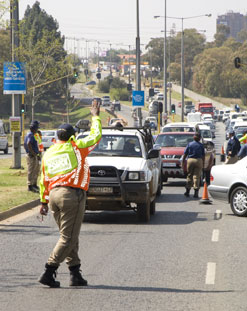
Drug-related crimes – using and selling – and driving under the influence of alcohol or drugs increased by 13.3% and 10.6%, the latter showing a big improvement over the previous figure of 25.4%, and illegal possession of guns increased by 2.4%. As these were not usually reported by the public, these crimes come to attention primarily as a result of police actions such as roadblocks, searches and intelligence collection.
An increase in these crimes may actually indicate that the police are more active, whereas a decrease may indicate reduced police activity.
“In some of the communities, with which we continuously engage, we have been able to subsequently record significant successes,” says Mthethwa. “The increase in drug detection, whilst it reflects a positive trend, also concerns us because it could also speak to an increase in the availability of drugs in the country.”
The Centre for Justice and Crime Prevention found in its 2005 National Youth Victimisation Study that between September 2004 and September 2005, 41.5% of South African children and youth aged 12 to 22 were victims of crime or violence, or almost one in two.
Young people, it seems, are twice as likely as adults to be victims of crime and violence.
It found that 46% of young males had been victimised, against 37% of young females. One in five (16.3%) young people claimed to have been threatened or harmed at school. One in six (1.7 million youngsters) were assaulted in 2005.
About one in five young people, or 2-million children and youth, were victims of theft in the 12 months studied; about one in 10 were robbed. Tellingly, the study found that only one in 10 cases of assault of young people and children were reported to the police.
Copyright Brand South Africa © 2025. All rights reserved - Reengineered by Pii Digital